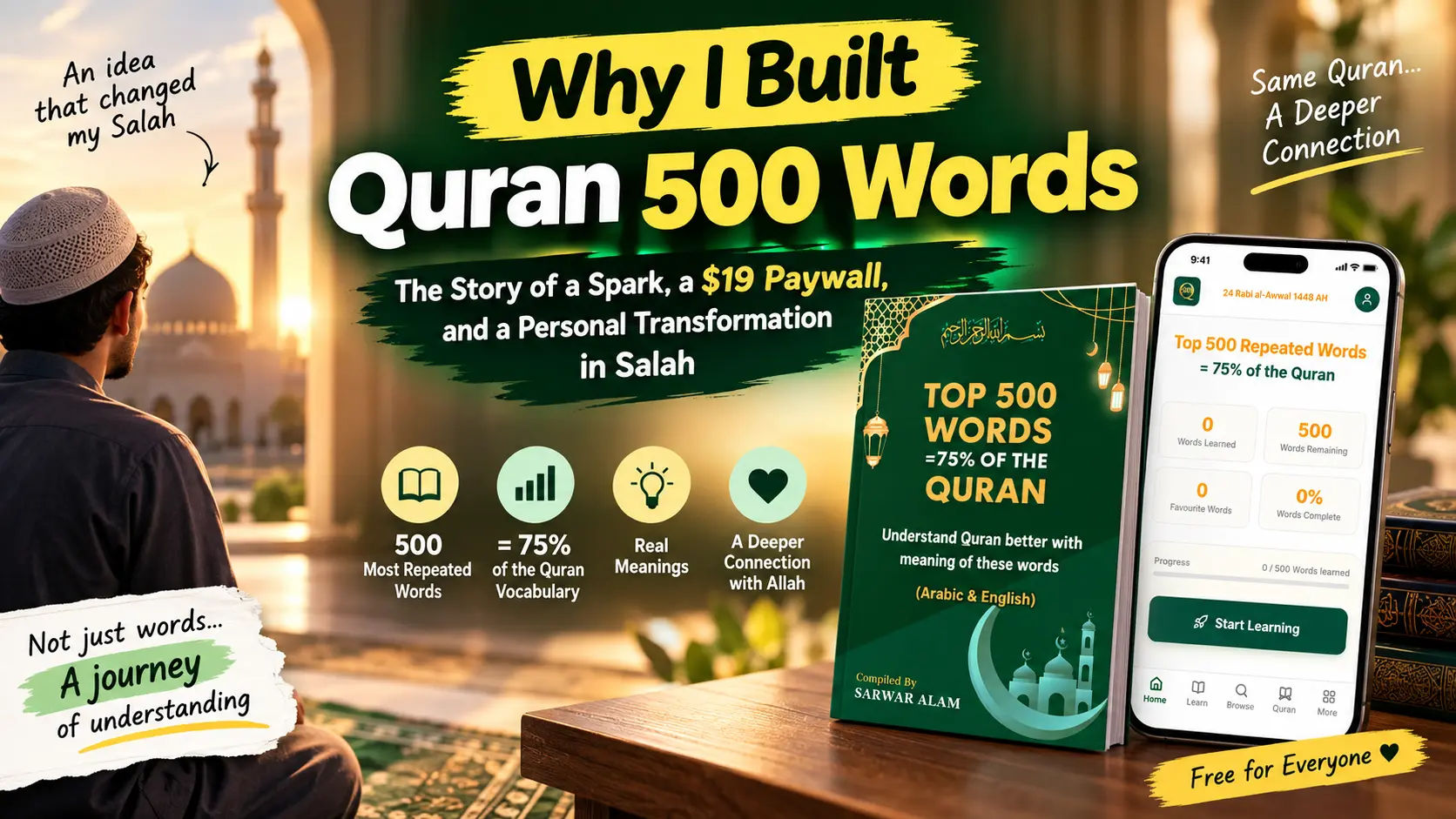
Why I Built ‘Quran 500 Words’
Assalamu Alaikum.
My name is Sarwar Alam. By profession, I am a software engineer—someone who spends his days building digital architectures, writing code, and trying to solve complex logical problems. But behind the terminal and the IDE, I am just a Muslim trying to navigate my faith, understand my Creator, and figure out how to connect more deeply with the words I recite every single day.
If you are reading this, chances are you have felt that exact same disconnect. You stand on the prayer mat, whisper the ancient Arabic phrases of the Quran, and realize your mind is completely blank to their actual meanings. You say Rabbana aatina or Allahu Akbar, but the language remains a veil between your heart and your Master.
This is the story of how an annoying Instagram ad, a lack of pocket money, an ambitious 50-day challenge, and a fever that broke my streak ultimately led me to build Quran 500 Words—a platform created to tear down that veil for anyone who wants to learn, completely free of charge.
The $19 Ad and the "Free Deeni Knowledge" Trap
It all started on a lazy afternoon while I was scrolling through Instagram. A sponsored ad popped up on my timeline. It was promoting an eBook called Quran 500 Words—a guide promising to teach the most frequently repeated words in the Quran so anyone could understand a massive chunk of the text without needing a degree in Arabic linguistics.
It looked incredible. It looked clean, valuable, and genuinely useful.
Then I saw the price tag: $19.
Now, $19 might not sound like much to some, but at that moment, I simply didn’t have the spare cash for it. And that single moment of frustration cracked open a deeper, uncomfortable truth about our Muslim community—a cultural conditioning that we carry deep in our bones:
We expect all deeni (religious) knowledge to be 100% free.
Think about it. We will happily spend hard-earned money on Netflix subscriptions, gaming gear, dining out, lifestyle gadgets, and courses that teach us how to code, trade stocks, or build startups. We invest thousands into worldly skills without blinking an eye. But the exact moment someone puts a price tag on an Islamic product—whether it’s an app, an eBook, a course, or a physical planner—our collective attitude shifts.
We scoff. We call them commercial. We complain that “Islamic knowledge should never be sold.”
This mentality has become an unconscious habit. We want the best teachers, the cleanest apps, the most beautifully designed books, and deep spiritual insights, but we expect the people creating them to work entirely for free, running on pure air and good intentions. When it comes to Allah’s knowledge, we suddenly turn stingy, expecting miracles while refusing to support the infrastructure required to build them.
Annoyed, I swiped away and ignored the ad. But the algorithm, doing its relentless job, kept feeding it back to my timeline day after day.
From a Raw Text File to a 500-Page Monster
The constant exposure planted a seed of curiosity. If this eBook is so popular, I thought, there must be a core logic to it. The foundational premise was brilliant: the Arabic language in the Quran relies heavily on repetition. If you learn the top 500 most frequently occurring words, you suddenly unlock roughly 70% to 80% of the entire Quran’s vocabulary.
I decided to investigate.
I opened Google and started searching. After a bit of digging, I actually found a public database containing a raw list of about 5,200 words from the Quran along with their raw frequencies (how many times they appeared).
There was just one massive problem: It was completely useless to an ordinary learner.
It was just a dry, endless spreadsheet of Arabic words and numbers. No meanings in English, Hindi, or Urdu. No contextual verse examples showing how the word is actually used in a sentence. Just cold, isolated data.
As a software engineer who works with AI, I knew I had a toolbox at my disposal. I didn't want to buy a $19 eBook anymore; I wanted to see if I could engineer the solution myself. I wrote a script and used AI to process those words in intelligent batches of 10 to 15. I pulled their accurate meanings, rooted patterns, and brief, precise verse examples from the Quran.
Hour after hour, batch by batch, I filtered, refined, and structured the data until I had a clean, comprehensive corpus of the top 500 most frequent words.
Now I had a massive block of text sitting on my local machine. It looked terrible. It felt unreadable, dry, and intimidating—like reading a dictionary straight through.
So, I took the raw text over to Canva. I spent days designing layouts, structuring pages, formatting typography, and transforming that raw data into a gorgeous, comprehensive digital eBook stretching across 500 pages.
I sat back, looked at the final product, and realized I was holding a complete digital product in my hands. The question hit me hard: What do I do with this? Do I keep it locked on my hard drive for myself, or do I share it with the world?
After designing sleek front and back covers, I put the finishing touches on the draft. I set up a landing page, branded it Quran 500 Words, uploaded the digital file to platforms like Superprofile and Gumroad, and stepped into the arena of content marketing.
The Sound of Silence (and the 30-Day Challenge)
For the next one to two months, I posted consistently on Instagram. I created Reels, designed carousels, wrote engaging hooks, and tried to push the product out into the world.
And absolutely nothing happened.
Zero traction. Zero sales. Just the deafening silence of an empty internet void.
It is deeply frustrating to pour your soul, late nights, and technical skills into something, hit publish, and watch the digital world walk right past it. I felt defeated. But as Muslims, we are taught to put in our absolute best effort (our amal), trust the process, and leave the results to Allah. He knows our true intentions better than anyone else.
Time slipped away. Life happened. I got deeply invested in other professional goals, software projects, and daily responsibilities, and Quran 500 Words quietly gathered digital dust on a shelf in the back of my mind.
Then, last year, right before Ramadan—exactly 30 days before the blessed month began—something shifted inside me.
I looked at my spiritual state and felt an overwhelming sense of inadequacy. I made a bold, somewhat reckless challenge to myself: I am going to learn all 500 words in 50 days.
For the first 25 days, I was an absolute machine. I didn't miss a single day. I carved out time every single morning, memorizing roots, reviewing meanings, and testing myself. The discipline felt incredible.
And then, disaster struck.
Right in the middle of my momentum, I caught a severe viral infection. I came down with a high fever that knocked me flat on my back for 4 to 5 days. I couldn't look at a screen; I could barely get out of bed. My unbroken continuity—my precious streak—was shattered.
When the fever finally broke and the brain fog lifted, it would have been so easy to quit. Most people do. Once a habit streak breaks, the psychological barrier to restart feels monumental.
Instead, I dragged myself back to the desk. I didn't hit my original 50-day target, and I didn't finish all 500 words within that exact window. But I kept going. I pushed through for another 12 days.
As of today, I have successfully mastered 370 out of the 500 words.
Did I fail my initial rigid challenge? Technically, yes. Did I fail the journey? Not by a long shot. Because in the process, I learned something profound that I didn't know yesterday.
The Transformation of Salah
Numbers and statistics on paper don't mean much until they touch your real life. For me, the real victory didn't happen on my laptop screen—it happened on my prayer mat.
About two weeks into my vocabulary journey, I started noticing subtle, beautiful shifts during salah (prayer).
Standing in the quiet of the room, bowing in ruku, and prostrating in sujud, words that used to be meaningless background noise suddenly flared up with crystal-clear clarity.
- When I heard or recited Inna (Indeed/Surely), my mind registered it instantly.
- When Min (From) or Alladhī (Those who / The one who) rolled off the tongue, they weren't just abstract sounds anymore; they carried immediate semantic weight.
It completely transformed my experience of prayer.
For the first time in my life, I wasn't just performing physical choreography while my thoughts wandered to codebases, deadlines, and worldly worries. I actually knew what I was saying to Allah. When I recited His words, I understood the direct guidance that our beloved Prophet Muhammad (صَلَّى ٱللَّٰهُ عَلَيْهِ وَسَلَّمَ)—Peace Be Upon Him—had delivered to humanity from the heavens.
Peace be upon him (صَلَّى ٱللَّٰهُ عَلَيْهِ وَسَلَّمَ).
And that realization broke my heart for our community.
Why Non-Arabic Speakers Are Left Behind
We live in a massive global ummah where the vast majority of Muslims are non-Arabic speakers. Millions of people across South Asia, Southeast Asia, Europe, and the Americas grow up reciting the Quran in Arabic with beautiful tajweed, but with zero comprehension of the actual text.
Think about how tragic that is.
We stand before the King of the Universe five times a day, whispering deeply emotional pleas, seeking forgiveness, asking for paradise, and listening to divine commands—and we have absolutely no idea what words are leaving our lips.
This profound language barrier is the number one reason why so many young people—and adults alike—feel entirely disconnected from Islam. They view prayers and Islamic rituals as a rigid, lifeless chore, a mechanical ritual they must check off their daily to-do list before running back to things they actually understand.
And those who do pray regularly often feel an aching spiritual emptiness because their heart is operating in the dark while their tongue is moving on autopilot.
I realized: If this simple vocabulary shift changed my entire relationship with salah, why am I keeping this locked away?
Building ‘Quran 500 Words’ as a Free Gift to the Ummah
After working tirelessly for another month, combining my software engineering background, my design experience, and my personal learning notes, I built Quran 500 Words from the ground up as a dedicated platform.
My vision for this platform is simple and uncompromising:
Anyone who genuinely wants to learn the language of the Quran can come here and learn it—completely for free.
I remember the $19 paywall that locked me out when I was broke and searching. I refuse to let financial barriers stand between a believer and the words of their Creator. Knowledge of the Quran shouldn't be gated behind credit cards and subscription models for those who can't afford it.
That being said, let’s address the elephant in the room—returning to what I mentioned earlier about our community's mindset.
While this platform is free for everyone to use and learn from, maintaining servers, building features, designing educational content, and dedicating hundreds of hours requires resources. If you use this platform, benefit from it, and have the financial capacity to contribute, please support it. Buy a coffee, drop a contribution, or back the project.
We need to break the toxic community habit of expecting all deeni work to be freebies while letting quality Islamic initiatives starve due to a lack of funding. Supporting creators and platforms that build infrastructure for our faith is an investment in our own future.
A Final Word to You
If you’ve read this far, I want to thank you.
Whether you are a student, a working professional, an elder, or a young person struggling to find focus in your prayers, know that you are not alone. I built this platform out of my own struggle, my own ignorance, and my own desperate desire to understand what my Creator is saying to me.
If a guy who spends his days writing code can open up the Quran and finally understand what he is whispering in salah, so can you.
Step onto the platform. Take the first word. Break the barrier.
Jazakallah Khair for reading my story. I pray that Quran 500 Words becomes a light for your heart, a transformation for your prayers, and a source of continuous benefit for you and your family.
May Allah accept our small efforts, forgive our shortcomings, and open our hearts to His Book.